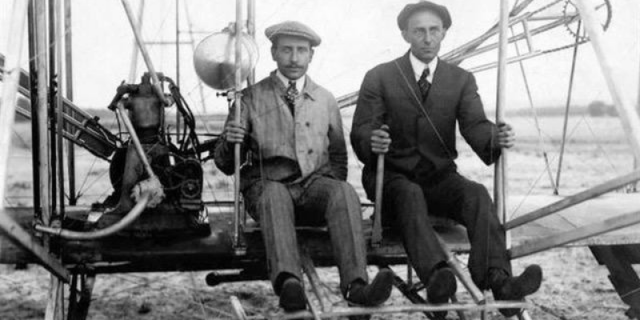
In 1903 the Orville and Wilbur Wright, two young men from Dayton, Ohio with only a high-school education and limited financial resources, took the world into the aviation age. The Wright Brothers made powered flight possible by solving a problem – “the flying problem” – that had long vexed others; that is, how to turn an aircraft and maintain it in level flight. The Wright Brothers’ invention of the three-axis control system allowed the pilot to effectively turn the aircraft and maintain its balance. Their method is still used to steer fixed-wing aircraft today. (i)
Where others had tried to solve the flying problem through more powerful engines or automatic balancing mechanisms, the Wright Brothers instead took a different approach. They applied what they had learned from designing and building bicycles. In the Wright Brothers’ day the bicycle was a relatively recent technology. Bicycle use first became widespread in Europe and America during the “bicycle craze” of the 1890s, only a decade before the famous “Wright Flyer” made its debut flight at Kitty Hawk, North Carolina on December 17, 1903. The Wright Brothers saw that the mechanics of riding an inherently unstable vehicle such as a two-wheel bicycle could also be applied to flying. It must be said that the Wright Brothers were by no means the only people to look to the bicycle as a source of inspiration for powered flight. In the 1890s many believed that powered flight was the next logical step from the bicycle. (ii) Many in the scientific community were on the other hand skeptical. So were the pundits of the era. In 1903, the same year of the Wright Brothers’ breakthrough, the New York Times predicted that it would take from one to ten million years before human flight would be possible. (iii)
What the non-scientists were able to see that eluded many experts was a result of real-world experience and creative thinking. To early cyclists, riding a bicycle gave the sensation of flying. Furthermore, as anyone who has ever ridden a bicycle knows, we are able to maintain balance and steer a bicycle by making constant tiny unconscious adjustments. From this knowledge of bicycles, the Wright Brothers figured out that a flying machine did not need to be stable, but that it could be flown much the way a bicycle is ridden; that is, through balancing and reflex action gained through experience. The Wright Brothers also closely observed birds and designed the wings of their airplanes to warp when the pilot turned, just the way birds angle or alter the shape of their wings in order to turn in flight. [iv]
The Wright Brothers’ success in applying what they knew about bicycles and birds to solving the problem of controlled flight was an excellent example of lateral thinking. Although the term lateral thinking is often attributed to Maltese Psychologist Edward De Bono, the practice of lateral thinking is probably as old as thinking itself. In fact, scientists frequently make discoveries due to investigations carried out in seemingly unrelated fields of research. For example, Pasteur’s demonstration of molecular chirality (molecules with a non-superimposable mirror image) was likely partly due to his experiences as a lithographic artist.[v] Einstein’s mental visualizations of trains helped generate ideas that he would eventually incorporate in his theories of relativity.[vi] Robert Goddard, the father of modern rocketry, got his inspiration for space flight when he climbed a tree as boy and had a birds-eye view of the fields around his New England home.
Creative and outside-the-box thinking often comes when people apply knowledge or experience from a wholly unrelated field or area of expertise to the problem or challenge they are facing. Moreover, many of us have had the experience of solving a knotty problem when we are not directly focused on it.
This apparent paradox is the result of insight, that new awareness that emerges from the non-conscious mind spontaneously when multiple brain regions connect in new ways. We often experience this as an “aha” moment when we are able to solve a problem by accessing a whole different level of thinking or by suddenly seeing something that we had not seen before. Once we have seen it, the solution appears obvious. This is a non-linear process that stems from the formation of new mental maps in our brain. The creation of these new neural connections physically changes the brain and leads to a burst of energy as neurotransmitters, especially dopamine and norepinephrine, are released. There is evidence that at the moment that we have an insight, the brain generates high-frequency gamma-band waves, which are correlated with simultaneous activity across multiple brain regions.[vii]
Obviously, only a rare few of us can have the type of insights that the Wright Brothers, Einstein and Pasteur had. But most of us have had the experience of figuring something out or coming up with a creative idea when we are doing something wholly unrelated, such as taking a shower, washing the dishes or exercising. While the topic of the neuroscience of insight and creativity is a huge area of research and not fully understood, there are some practical things that we can do to make these seemingly random “aha” moments more frequent.
Quiet your mind and if possible seek out a peaceful environment
In order to access insights that emerge from our unconscious mind, we need to be able to notice them emerge. This requires quiet. Research has shown that some of the most frequent places and times where people report having insights are at night, while taking a shower, at home, when it is quiet, while in transit, while exercising and when in nature.[viii] This means that if we want to make insight more likely, we should build moments of quiet and solitude into our day. This can include time for walking, exercise, mindfulness, and quiet reflection. Even simply getting up to stretch for a few minutes or scheduling five minute breaks between meetings can be beneficial.
Inward Focus and Mind Wandering
Insights are more likely to arise when we focus on our own thinking and tune out what is going on around us. Research on the cognitive neuroscience of insight by Mark Jung-Beeman has shown “that insight is the culmination of a series of brain states and processes operating at different time scales.”[ix] As opposed to the way we normally think of problem-solving as a deliberate, linear, and conscious process, insights are generated unconsciously and emerge into consciousness suddenly. Neuroimaging studies have demonstrated that right before having an insight our brain generates alpha-band waves in the visual cortex. In fact, the presence of these alpha-band waves may be necessary in order to have an insight. Jung-Beeman has observed that when people are about to have an insight they tend to go quiet and often look up and away, focused on their own thoughts.[x]
Research also shows that when we stop thinking about something specific and let our mind wander, we activate the Default Mode Network (DMN), the brain’s resting state circuitry. The DMN consists of diverse bundles of neurons collectively called a connectome that light up in the brain when we are not focused on a specific task or have completed a task.[xi] The DMN enables creative imaginative and broad thinking. This means that rather than frowning on day dreaming and mind wandering, we should actively cultivate this mental state for a certain period of time each day.
Although it may not feel productive, time out for mind wandering or simply doing nothing is more likely to cultivate the emergence of insight and creativity and to make connections between concepts. This also reinforces the importance of limiting the time we spend looking at our phones, especially during our free time. Or as Bertrand Russell said in his work In Praise of Idleness, “there is far too much work done in the world.”
Resourceful State of Mind – Relaxed, Slightly Happy and in Flow
Another condition conducive to having an insight is the feeling of being relaxed and slightly happy. Not the feeling of euphoria or joy, but when we are open, curious and interested in what we are doing. This is related to Positive Psychologist Mihaly Csikszentmihalyi’s Flow State, “the mental state in which a person performing some activity is fully immersed in a feeling of energized focus, full involvement, and enjoyment in the process of the activity.”[xii] When we are moving toward a goal or engaged in an activity that fully engages us, we have a wider field of perception, heightened awareness and creativity, greater cognition and a greater willingness to collaborate with others. Anxiety, on the other hand, is the enemy of insight, as it increases the activity of the limbic system, particularly the amygdala, which is especially aroused when we feel threatened. When we are hijacked by our amygdala it is as if we are wearing blinders and we can see only a limited range of options: the famous flight or fight response.
When you hit an impasse, stop thinking directly about the problem or challenge
A common experience of insight is that it often occurs when we are not directly focused on the problem or challenge. According to psychologist Stellan Ohlsson’s “inhibition theory,” [xiii]we have to inhibit old thinking in order for more creative thinking to emerge. This is because we often look to the past for tried and true solutions that we could apply to the current dilemma. But this is unlikely to lead to creative breakthroughs. This probably explains why novices can sometimes see solutions that have eluded experts. When you are an expert, your deeply ingrained knowledge and assumptions can prevent you from looking at a problem in novel ways. This is not to say that expertise is negative. However, even experts can benefit by cultivating a beginner’s mind.
When we hit an impasse, often the best thing to do is to put it aside and do something wholly unrelated to the problem we are trying to solve, even better if the activity is interesting or fun. Or sometimes, we just need to sleep on it. I often notice this when I am learning a new piece on the piano. After a night’s sleep or a couple of days of rest, I am able to play something that had eluded me the last time I had sat at the piano. When we take or break and stop thinking directly about the problem, we allow broader connections and associations to emerge from the non-conscious mind. The non-conscious resources of the brain are far larger than the conscious ones and are constantly working, even when we are sleeping.
A similar phenomenon seems to occur with happiness. According to Tal Ben-Shahar, Professor of Happiness Studies at Harvard University, there is a paradox in that if our goal is the direct pursuit of happiness, we are actually less likely to be happy. Instead, happiness arises when we pursue it indirectly. In his SPIRE model, Ben-Shahar maintains that we can become happier overall if we focus on the components of well-being which include the spiritual (finding meaning and purpose, not necessarily religious), physical, intellectual and artistic, relational and emotional.[xiv]
Cultivate meta-awareness
Meta-awareness is an awareness of your own thinking and your own emotional state. For example, becoming a aware of how we are approaching the problem rather than the problem itself. Are we lost in details? Do we need to zoom-out to look at the situations from a wider perspective or a different angle? Are we feeling anxious? Tired? Are we trying too hard? In cultivating meta-awareness we quiet our thinking and allow it to pick up subtle signals from the non-conscious mind. Meditation or mindfulness practice is an excellent way to develop meta-awareness that can lead to insight. We can also help another person to develop meta-awareness by helping them to see their own thinking. Often it can be difficult to become aware of our own thinking patterns because they are so habitual. This is why working with a coach often leads to insights. A good coach can help a client to reveal and disrupt their own thinking.
Conclusion
In this article, I have given a brief overview of some of the neuroscience behind insight. Insight is closely related with creativity and innovation, and thus is increasingly needed to address the pressing problems of our current times. Although the creative process is not even close to being fully understood by science, we do know that we can create mental states and situations in which insights are more likely to emerge. I hope that I have provided the reader with some useful advice on how to create more insightful moments.
(i) Wright Brothers, “Wikipedia,” https://en.wikipedia.org/wiki/Wright_brothers
[ii] Guroff, M. (July 2016). “The Untold Story Of How Bicycle Design Led To The Invention Of The Airplane.” Fast Company. https://www.fastcompany.com/3061592/the-untold-story-of-how-bicycle-design-led-to-the-invention-of-the-airplane
[iii] Pomeroy, R. (June 2023). “For years, the media ignored the Wright brothers’ breakthrough flight. Why?” Big Think. https://bigthink.com/the-past/wright-brothers-ignored/
[iv] Guroff, M. (July 2016). “The Untold Story Of How Bicycle Design Led To The Invention Of The Airplane.” Fast Company. https://www.fastcompany.com/3061592/the-untold-story-of-how-bicycle-design-led-to-the-invention-of-the-airplane
[v] Morgan RM, Kneebone RL, Pyenson ND, Sholts SB, Houstoun W, Butler B, Chesters K. (April 2023). “Regaining creativity in science: insights from conversation.” R. Soc. Open Sci. 10: 230134. https://doi.org/10.1098/rsos.230134
[vi] Henni, Y. PhD. (January 2021). “Lateral Thinking Helps You Become More Creative.” Medium. https://dr-younes-henni.medium.com/how-lateral-thinking-can-make-you-more-creative-and-better-at-learning-75a684b10ff
[vii] Rock D. Your Brain at Work: Strategies for Overcoming Distraction, Regaining Focus, and Working Smarter All Day Long. New York: HarperCollins Publishers, 2009. p. 82-83.
[viii] Ovington L, Saliba A, Moran C, Goldring J, MacDonald J. (November 2015). “Do people really have insights in the shower? The when, where and who of the aha! Moment.” Journal of Creative Behavior https://doi.org/10.1002/jocb.126
[ix] Kounios J, Beeman M. (August 2009). “The Aha! Moment: The Cognitive Neuroscience of Insight.” Current Directions in Psychological Science. Vol. 18, No. 4, pp. 210-216. https://www.jstor.org/stable/20696033
[x] Ibid
[xi] Hallowell E., Ratey J. ADHD 2.0. New York: Ballentine Books, 2023. p. 23-24.
[xii] Flow, “Wikipedia,” https://en.wikipedia.org/wiki/Flow_(psychology)
[xiii] Rock, Your Brain at Work, p. 77-78.
[xiv] https://www.youtube.com/watch?v=e-or_D-qNqM&t=362s&ab_channel=BigThink
 Stephen Artinian